

It proposes a total freeze on new income for the next ‘three years’ until the PGOU is modified.
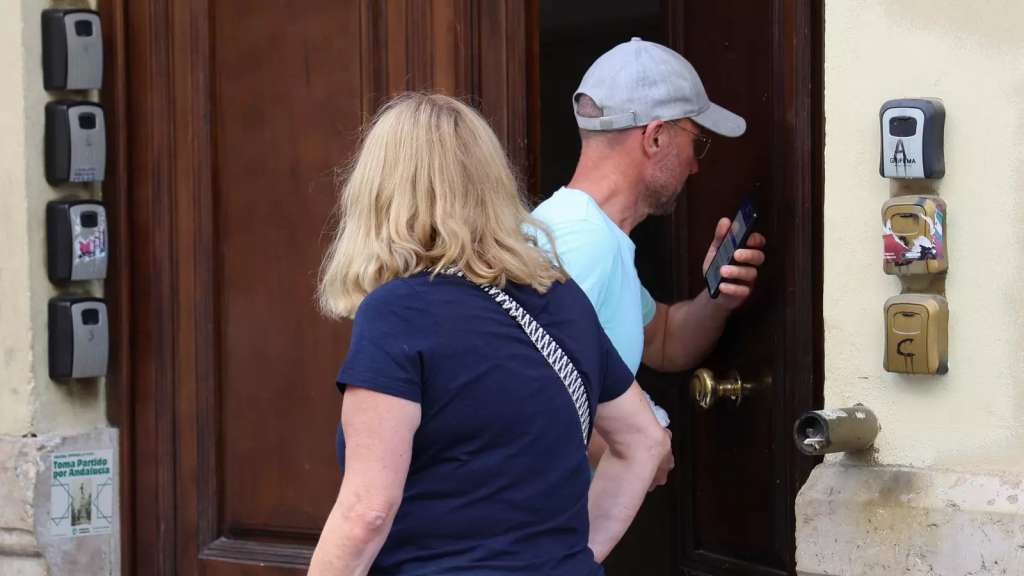
The Mayor of Málaga, Francisco de la Torre, has announced a ‘global moratorium’ that will prohibit the registration of new tourist flats for the next three years. The time until the modification of the General Urban Development Plan (PGOU) that he has already announced and which will regulate the possibility of implementing new holiday rentals in homes in the city.
The measure, he said, will be approved in one of the following Local Government meetings, ‘this week or next week, imminently’. In this way, it could be approved this Friday. It is worth remembering that next Saturday, 5th April, a demonstration for housing has been called in Malaga, which will be the third to be held in the last year. The mayor has dropped his suspicions that it could be organised by the left-wing political parties.
De la Torre wanted to underline ‘the will we have in terms of housing’, adding the moratorium that he said will be approved to the two that regulate tourist flats that are already in force. So far the City Council has already banned new holiday rentals in those homes that do not have a separate entrance, as well as prohibiting them in those neighbourhoods, 43 right now, which are above 8% of total residences.
‘The measures we have taken so far we cannot call them a moratorium, but they are equivalent to a moratorium or more than a moratorium because we have not put a limit on the duration of the independent entrance, we have not put a limit on the 8% limit, it is for saturated areas, and the moratorium is a temporary issue of three years, linked to the issue of the Plan,’ he said.
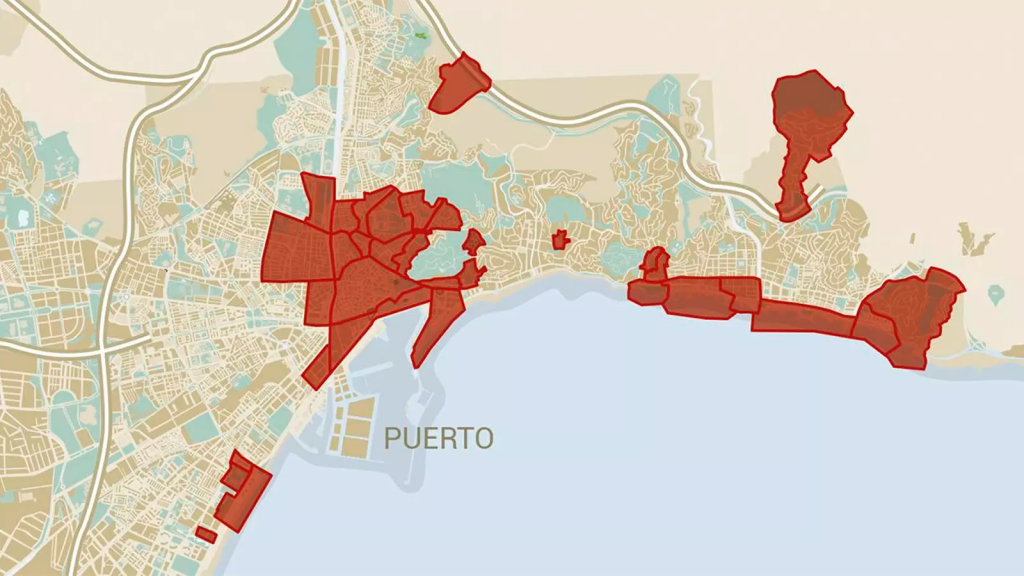
Neighbourhoods where no more tourist flats may be created.
Under this argument, that the measures already taken, the mayor has repeatedly rejected the proposal of the PSOE and Con Málaga to implement the moratorium he is now announcing. Since the last election campaign the left-wing groups have been calling for a total moratorium.
The councillor also referred to the 16 cranes that are working in the Universidad sector to build more than 1,000 subsidised housing units. ‘We are doing what is in our hands,’ he said, while calling for more European funds to build social housing or for the government to allow the tourist tax that it intends to use for this purpose.
As for the tourist flats, he pointed out that a company is about to be contracted to show a ‘real image’ of the tourist flats that are working right now in the city, beyond the total registered with the Junta de Andalucía with the possibility of doing so. This would also help to detect illegal ones, he said. It is worth remembering that the National Statistics Institute (INE) already carries out a study twice a year using the scraping technique on platforms, i.e. it combs the most common portals when advertising to show how many there are in the city and the province.
He added that ‘this study is key to being able to have a compass to guide us in this matter’. However, he valued that ‘we have achieved a reduction that obviously facilitates, obviously, that there is more supply in long term housing, not short term housing such as tourist housing’.
Up to 1,400 more VPOs due to a Junta decree
De la Torre also pointed out that in Thursday’s plenary session they will adhere to a decree of the Junta de Andalucía which makes it possible to increase the buildability of land already dedicated to VPOs by an extra 20%. In addition, it also allows an increase in this proportion on land destined for free housing, but which is intended to change to the construction of VPO. With this, municipal estimates suggest that 1,400 more VPOs could be built.
In a first phase, these measures will be applicable to a total of eleven public, private and public-private subsidised housing developments on urban land under transformation. Thus, thanks to the application of the measures in this decree, it will be possible to build 414 more subsidised housing units than initially planned.
Malaga City Council, through the Urban Planning and Housing Departments, is working on the future application of the rest of the measures included in the Decree which, firstly, means that on land that is in the transformation stage without the urbanisation being carried out, such as Soliva Oeste, Buenavista or Lagar de Oliveros, which currently have 5,114 subsidised housing units, can increase by 20% the number of subsidised housing units and 10% of the buildable area allocated in the General Plan (PGOU), which would add up to 1,023 subsidised housing units more than the number planned in the PGOU. 114 subsidised housing units can increase by 20% the number of subsidised housing units and by 10% the buildable area allocated in the General Plan (PGOU), which would add up to 1,023 more subsidised housing units than those foreseen in the PGOU.
The Consistory will implement these measures, which will be approved tomorrow, in two phases: one immediately on vacant plots or plots of urban or developable land that are in a state of urban transformation with an approved urbanisation project and in the phase of its material execution; and a later phase that deals with urban or developable land, pending its urban transformation, but with approved detailed planning and that would be transformed over the course of 2025.
Finally, the Plenary will also approve, as determined by the Decree, to establish a maximum period of two years from the publication of the plenary agreement to apply for the building permit and a period of three years for its execution from the granting of the permit.


